
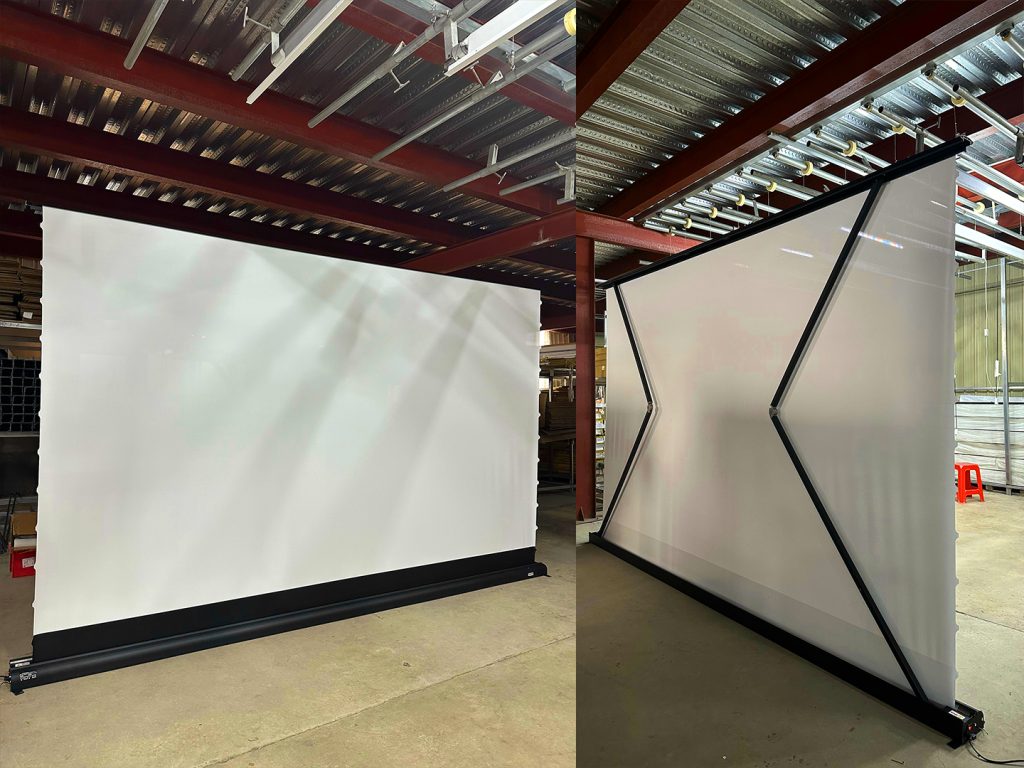
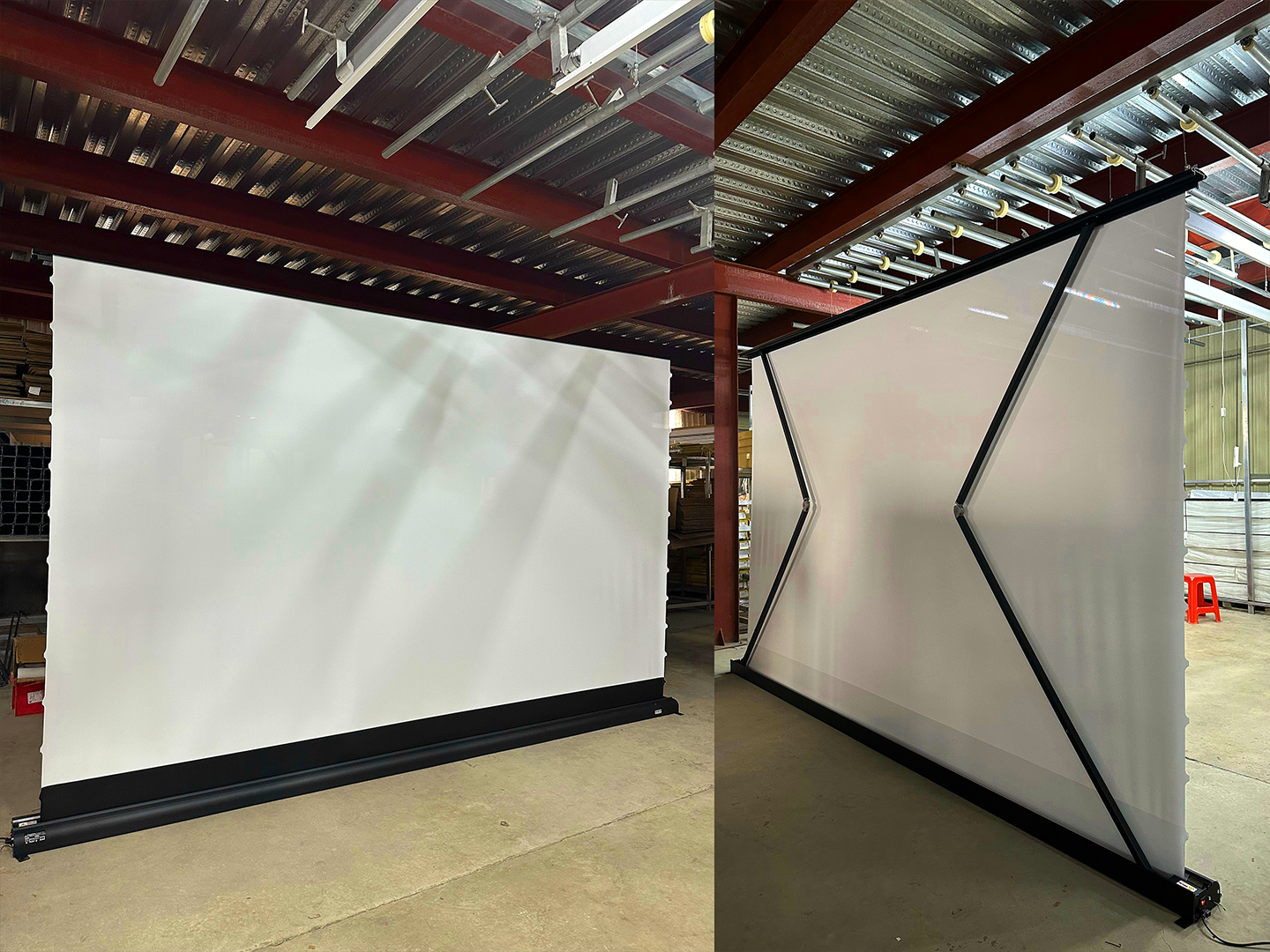
In engineering scenarios such as government and enterprise lecture halls, high-end hotel ballrooms, and commercial exhibition halls, motorized floor-rising screens have become a popular choice for B-end procurement due to their advantages of no ceiling suspension, easy installation, and adaptation to refined decoration spaces. However, after long-term high-frequency lifting, large-size motorized floor-rising screens almost suffer from a common industry problem of edge curling on both sides. Distorted picture edges and irregular projection frames not only directly affect viewing and display effects, but also reduce the overall project delivery reputation. Many project parties fall into the dilemma of repeated after-sales service due to this physical problem. Many people wonder why floor-rising screens have particularly serious curling problems compared with other electric projection screens, and how to completely solve it from the aspects of design and technology.
Core Causes of Edge Curling: Not Only Materials, But Also Dual Tests of Mechanics and Scenarios
Many people attribute edge curling to poor screen materials. In fact, in B-end high-frequency usage scenarios, the curling of motorized floor-rising screens is the result of the combined action of mechanical structure, environmental changes and usage intensity, which cannot be resisted by ordinary processes in the long run.
The stress logic of the floor-rising structure has an inherent shortcoming. The screen is lifted upward by the bottom support arms throughout the process, and the downward gravity pull forms a continuous game with the upward thrust of the support arms. Large-size frames will magnify this stress imbalance exponentially. The lack of effective tension constraints on both sides of the screen leads to an upward curling trend over time. Coupled with environmental fluctuations in commercial scenarios, such as direct blowing of hot and cold air from air conditioners and frequent changes in indoor temperature and humidity, screen substrates such as PVC and fiberglass will expand and contract, internal stress will gradually lose balance, further aggravating edge deformation.
From a physical perspective, the edge curling phenomenon of motorized floor-rising screens is essentially the creep of materials — that is, the slow and irreversible plastic deformation of materials under long-term constant load. This is why even if ordinary floor-rising screens meet the flatness standard initially, edge curling will still occur after long-term use, which is precisely the core pain point ignored by many low-end manufacturers.
In addition, many low-end products on the market use simple brackets and rough processing technology, resulting in poor synchronization of support arms and no tension compensation on the sides. Dozens of lifting operations every day will only make the edge curling problem more serious, which is also the core gap between engineering-grade motorized floor-rising screens and ordinary household models.
The “Mechanical Collapse” Process of Ordinary Floor-Rising Screens
When purchasing, B-end customers not only pay attention to “how to solve edge curling”, but also care about “why edge curling is inevitable”. An in-depth analysis of the mechanical failure process of ordinary floor-rising screens can better reflect ZSM’s R&D depth and industry insight:
- Initial Stage: When the support arm rises, the stress is concentrated in the center of the screen, and the edges on both sides are in a naturally relaxed state. At this time, the internal stress of the substrate is in initial balance, and there is no obvious edge curling, but hidden dangers have been planted;
- Fatigue Stage: High-frequency lifting dozens of times a day in commercial scenarios will lead to a 0.5mm mechanical gap at the connection of the support arm. This tiny gap will break the stress balance and further weaken the stress on both sides of the screen;
- Stress Release: Due to the lack of effective tension constraints, the edge substrate, driven by changes in ambient temperature and humidity, will have slow molecular chain displacement, gradually curling inward (the direction with less stress), and this deformation is irreversible;
- ZSM Conclusion: For floor-rising screens without physical cable tension compensation, edge curling is an irreversible physical necessity for large-size specifications above 200 inches, which is a common technical bottleneck for large-size motorized floor-rising screens in the industry.
ZSM Multi-Dimensional Anti-Curling System: Solve the Problems of motorized floor-rising screen anti-curling from the Design Source
In response to the long-term use needs of engineering scenarios, ZSM has developed an exclusive anti-curling stability system through multiple rounds of R&D and actual measurements. It solves the problems of motorized floor-rising screen flatness and durability from three dimensions: substrate, structure and tension control, adapting to various commercial large-size customization needs, and meeting the professional standards of procurement.
Four-Layer Composite Substrate Structure
We abandon traditional single-layer or double-layer substrates, and adopt a four-layer composite process to create the main body of the screen. Each layer is designed to solve stress deformation and creep problems in a targeted manner, forming a distinct contrast with ordinary floor-rising screens. The specific parameters are as follows:
| Comparison Item | ZSM Engineering-Grade Motorized Floor-Rising Screen | Ordinary Motorized Floor-Rising Screen |
|---|---|---|
| Substrate Structure | Four-layer composite structure (high elastic base layer + fiberglass stabilizing rib layer + HD optical coating + anti-static protective layer) | Single-layer PVC or simple double-layer fiberglass |
| Tensile Strength | 165N/5cm, 110% higher than industry standards | 75-85N/5cm, only meeting basic standards |
| Creep Resistance | The fiberglass stabilizing rib layer has passed 3000 hours of static creep resistance test, and the dimensional change rate ΔL < 0.01% under 50℃ high temperature environment | No creep resistance design, molecular chains are prone to displacement after long-term stress, resulting in obvious edge curling |
| Optical Performance | Gain 1.2, color reproduction 92%, no coating cracking | Gain 0.8-1.0, color reproduction ≤75%, prone to coating peeling |
| Anti-Static Performance | Surface resistance 10⁹Ω, suitable for dusty commercial spaces | No special anti-static treatment, easy to absorb dust and accelerate aging |
Among them, the fiberglass stabilizing rib layer adopted by ZSM has passed 3000 hours of static creep resistance test. Traditional PVC screens are prone to molecular chain displacement (i.e., edge curling) under long-term stress, while our composite structure ensures that the dimensional change rate ΔL < 0.01% under 50℃ high temperature environment through physical cross-linking technology, eliminating edge curling caused by creep from the substrate level.
Precision Mechanical Structure and Tab-Tension Automatic Tension Compensation System
The scissor support arms are processed by CNC precision machinery, with a synchronous expansion error controlled within 0.1mm, ensuring uniform stress on the screen during lifting and avoiding edge curling caused by local offset. At the same time, it is equipped with ZSM’s exclusive Tab-Tension Automatic Tension Compensation System (i.e., side cable tension compensation system). This system is not simply adding two cables, but achieving constant tension through the spiral spring at the bottom, offsetting the uneven gravity caused by the “bottom support and top suspension” of the floor-rising screen, meeting the professional terminology needs of high-end projects.
To ensure the stress balance of motorized floor-rising screens at different heights, ZSM R&D team has established a side cable tension compensation model. The dynamic adjustment logic of its core tension T follows:
T=2⋅cos(ϕ)m⋅g⋅sin(θ)
Among them, m⋅g is the gravity load of the screen assembly (including the weight of the screen itself, support structure and accessories), θ is the real-time angle between the scissor support arm and the base (dynamically changing with the lifting height, ranging from 30° to 85°), and ϕ is the compensation angle between the tension cable and the horizontal plane (fixed at 15°, which is the optimal angle after multiple rounds of tests). This precise mechanical model makes tension adjustment more scientific, and also makes ZSM more authoritative in technical searches such as “floor-rising screen tension calculation”.
2026 Strict Testing Standards: Verify motorized floor-rising screen long-term use stability
All custom motorized floor-rising screens complete B-end engineering-level tests before leaving the factory and can be delivered only after meeting standards. The core test items are as follows, far exceeding the industry average standard:
- Cycle Life Test: 12,000 consecutive lifts, no creases or edge curling on the screen, no jamming in the mechanical structure, far higher than the industry standard of 8,000 times;
- Laser Flatness Detection: Detected by a high-precision laser scanner, the surface undulation error ≤0.4mm, better than the industry 0.5mm standard, and no picture ripples will appear even under 8K ultra-high-definition projection;
- Environmental Simulation Test: Continuous test for 72 hours in the environment of -15℃~50℃ temperature and 25%~85% humidity, no change in flatness, adapting to the environmental needs of different regions and different commercial scenarios;
- Creep Resistance Test: 3000 hours of static load test, no obvious deformation of the screen edge, and the dimensional change rate is always controlled within 0.01%;
- Flame Retardant Test: Passed B1 level (vertical method) and M1 level combustion test, meeting the fire safety requirements of commercial places.
2026 Industry Compliance Instructions
All ZSM engineering-grade motorized floor-rising screens comply with the latest 2026 industry compliance standards, which can directly meet the rigid filtering conditions for B-end scenarios such as government bidding, hotel procurement, and exhibition hall construction:
- Fire Protection Compliance: The product has passed B1 level (vertical method) flame retardant test and M1 level combustion test. In case of fire, it can slow down the spread of fire and reduce smoke generation, adapting to commercial scenarios with dense personnel, and complying with government bidding and hotel safety standards;
- Environmental Compliance: Passed UL 2818 certification and GREENGUARD air environmental protection certification, no harmful gas emission, adapting to high-end hotels, government and enterprise lecture halls and other scenarios with high environmental requirements, and can provide complete compliance test reports;
- Quality Compliance: All products have passed the inspection of the National Quality Supervision and Inspection Center, with no damage or stains on the screen, up-to-standard sewing technology, and meeting the quality acceptance standards of commercial projects.
Procurement Avoidance List
For engineering purchasers, they can quickly judge whether a product is prone to edge curling without professional equipment. Refer to the following points to avoid low-end product traps:
- Check the material of the support arm, give priority to aircraft-grade aluminum alloy, and avoid ordinary iron materials (easy to deform, rust, and aggravate edge curling);
- Confirm whether the side is equipped with Tab-Tension Automatic Tension Compensation System (i.e., physical cable tensioning device). For large-size models without tension structure, edge curling is an inevitable result;
- Ask about the substrate structure and creep resistance, give priority to multi-layer composite substrates, and require manufacturers to provide creep resistance test reports to avoid single-layer PVC screens;
- Check compliance certificates to confirm whether the product has passed B1/M1 fire certification, UL 2818 and GREENGUARD certification, to avoid failure to pass project acceptance;
- Require manufacturers to provide long-term lifting test reports, focusing on the flatness performance after more than 10,000 lifts, to avoid low-price products without process guarantee.
Frequently Asked Questions FAQ
Q1: What size of motorized floor-rising screen is most prone to edge curling?
A1: Generally, large-size models above 180 inches have a larger stress span and a higher curling probability. Therefore, they need more professional anti-curling technologies (such as Tab-Tension tension system and creep-resistant substrate) for support. For specifications above 200 inches, products without tension compensation will almost have irreversible edge curling.
Q2: Will the anti-curling structure of custom motorized floor-rising screens increase the difficulty of installation and storage?
A2: No, our Tab-Tension tension system and support arms are designed with lightweight. The storage volume is consistent with ordinary floor-rising screens, and the installation process adapts to commercial engineering standards, without additional installation costs and space.
Q3: Under high-frequency use in commercial scenarios, how long can the motorized floor-rising screen anti-curling effect last?
A3: Under normal use and maintenance, the anti-curling stability can be maintained for 8 to 10 years, much higher than the 3 to 5 years service life of ordinary products, which greatly reduces the later after-sales costs of B-end projects.
Q4: Will the three-color laser projection floor-rising screen produce ripples due to cable tension?
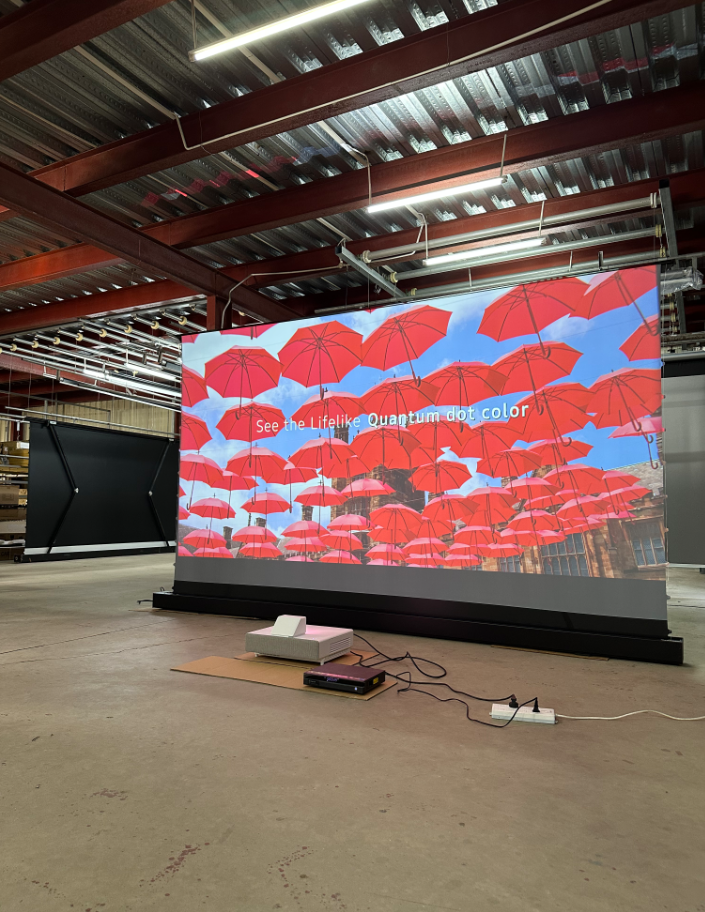
A4: No, ZSM 2.0 optical coating combined with Tab-Tension constant tension control maintains stable screen flatness under 8K high-frequency sampling, without ripples, distortion and other problems. It is suitable for high-end three-color laser projection scenarios and meets the needs of commercial high-definition display.
Q5: Can ZSM custom motorized floor-rising screens meet the compliance requirements of procurement?
A5: Yes, our products have passed UL 2818, GREENGUARD and M1 level fire certification, adapting to the standards of high-end engineering procurement. We can provide complete compliance test reports and support customized exclusive solutions with different sizes and processes.
For B-end projects such as hotels, governments, enterprises and exhibition halls, the stability of motorized floor-rising screens is directly related to project quality and later after-sales costs. ZSM focuses on the R&D and production of custom motorized floor-rising screens, and is deeply engaged in the field of projection screen customization. It can provide customized solutions for size, process and tension system according to different engineering scenarios, fundamentally solving edge curling problems, and meeting the 2026 industry compliance requirements. It provides long-term and stable product support for commercial projection scenarios, helping customers improve project delivery quality.
 Scan QR Code
ZSMSCR Facebook
ZSMSCR Instagram
ZSMSCR X
ZSMSCR YouTube
ZSMSCR TikTok