
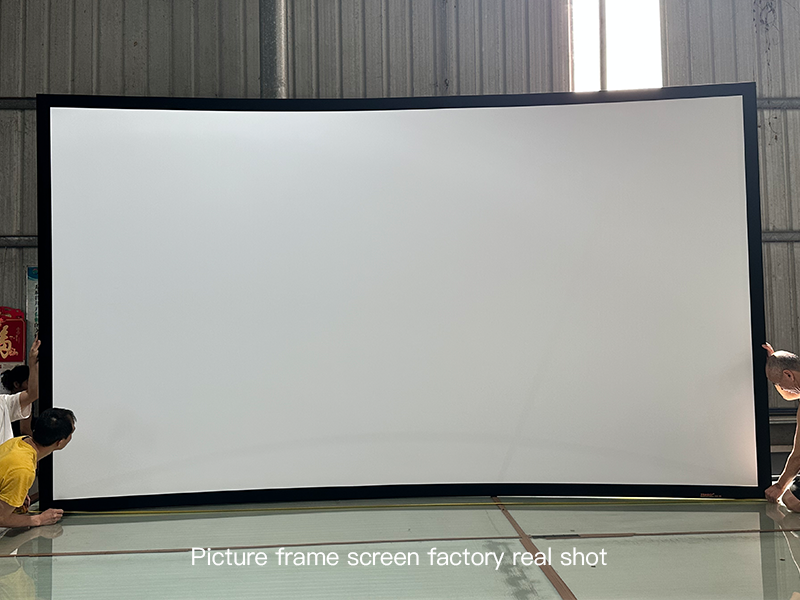
For overseas commercial cinema project purchasers, the fire retardant performance of cinema projection screens is never an optional extra, but a core prerequisite for the project to pass local fire inspection and be successfully implemented. Among them, B1 grade cinema projection screens are the mainstream compliance standard, widely used in various public places such as commercial cinemas and auditoriums around the world. However, their fire retardant requirements are significantly different from those of home projection screens. Many overseas B-end customers are likely to confuse the two standards when purchasing, which may lead to compliance risks. Today, we will analyze the core differences between the two from the aspects of standard details, process technology and overseas compliance requirements, and provide references suitable for B-end procurement scenarios combined with the actual needs of overseas customized cinema projection screens.
In fact, the difference between the two essentially stems from the different application scenarios. As a public place with dense personnel, the fire retardant performance of cinema-grade large screens directly affects the evacuation time and property losses in case of fire. Home projection screens, on the other hand, are mostly used as home entertainment equipment, with relatively loose fire retardant requirements. Even some home products only have basic fire prevention properties and do not meet professional fire retardant grades. This difference in application scenarios directly determines the all-round differences between the two in fire retardant standards, processes and testing procedures. Especially for overseas B-end customers, understanding these differences is the key to avoiding procurement mistakes and compliance risks.
I. Core Differences: Comparison of Fire Retardant Standards Between Cinema-Grade Large Screens and Home Projection Screens
Globally, cinema projection screens used in commercial cinemas must comply with strict local fire retardant standards. Among them, B1 grade (flame-retardant material) is the basic requirement in most countries and regions. However, there is no mandatory unified standard for home projection screens, and most of them are voluntary certifications. The following table clearly presents the differences between the two in core standards and testing requirements, especially suitable for the procurement verification needs of overseas B-end customers:
| Comparison Dimension | Cinema-Grade Large Screens | Ordinary Home Projection Screens | Concerns of Overseas B-End Purchasers |
|---|---|---|---|
| Core Fire Retardant Standards | China: GB 8624-2012 B1 Grade (requiring FIGRA ≤ 250 W/s, PCS ≤ 3.0 MJ/kg); US: NFPA 701 (2019 Edition); Europe: EN 13501-1 (B-s1,d0); Germany: DIN 4102 B1 Grade; France: M1 Standard | No mandatory standards, some products comply with GB 50222 B2 Grade (non-mandatory), most overseas home products have no clear fire retardant certification | Need to match the standards of the country where the project is located, such as EN 13501-1 for EU projects and NFPA 701 test for US projects |
| Afterflame/Glow Time | Afterflame time ≤ 5 seconds, glow time ≤ 5 seconds, no burning drips or drips that extinguish within 10 seconds and do not ignite cotton pads | Afterflame time is mostly 15-30 seconds, some products have burning drips, no strict glow time requirements | Third-party test reports must be provided, clearly indicating the afterflame, glow time and drip test results |
| Smoke Toxicity | Must reach ZA1 Grade (FED ≤ 0.5), the concentration of toxic gases such as CO and HCN in smoke meets the requirements of GB/T 20285, and EU projects must comply with REACH regulations | No clear smoke toxicity requirements, some low-cost products release toxic gases when burned | Smoke toxicity test report is a necessary document for the acceptance of overseas public places |
| Testing and Certification Requirements | Must pass testing by third-party authoritative institutions (such as China National Inspection, EU CE Certification, US UL Certification), provide complete test reports and certification documents, and some countries require on-site sampling re-testing | Mostly self-tested by enterprises, no third-party authoritative certification, only marked with “fireproof” without specific test data | Certification documents must correspond to the standards of the country where the project is located to avoid acceptance failure due to inconsistent certification |
Global Compliance Mapping: Which Certificate Do You Need?
For overseas B-end purchasers, accurately matching the flame retardant compliance standards of the region where the project is located is the key to avoiding acceptance failure and reducing compliance risks. The core compliance requirements of different markets have their own focuses. The following compliance checklist can be directly used for procurement verification, adapting to the needs of various commercial cinema projects:
- North America: Focusing on NFPA 701 (Small & Large Scale) and ASTM E84 (Class A). NFPA 701 is divided into Test Method 1 (for materials ≤21 oz per square yard) and Test Method 2 (for materials >21 oz per square yard), which is suitable for different thicknesses of cinema projection screens; ASTM E84 Class A requires flame spread index (FSI) ≤25 and smoke development index (SDI) ≤450, which is a mandatory requirement for public theaters in North America to ensure low flame spread speed and less smoke generation during combustion[6][8].
- European Union: Targeting EN 13501-1 (B-s1, d0 is the gold standard for public theaters). Among them, B represents the main combustion grade (flame-retardant), s1 means low smoke production, and d0 means no burning drips, which can effectively prevent fire spread and reduce suffocation risks during evacuation, fully matching the fire safety needs of dense public places such as commercial cinemas[11].
- UK: BS 5867 Part 2 Type B. This standard is applicable to medium-risk commercial environments, including public theaters. The cinema-grade large screens need to pass the vertical flame test, requiring that the flame does not reach the edge of the sample and no burning debris falls, and it needs to meet the performance requirements after 12 washes at 40°C, which is the core compliance standard for cinema projects in the UK[9].
- Germany: DIN 4102 B1 (Non-dripping requirement). This standard classifies materials as flame-retardant (B1), requiring that the continuous burning time ≤5 seconds, no burning drips ignite cotton pads, and the carbonization length ≤150mm. It is basically equivalent to EN 13501-1 B-s1,d0, which is a necessary condition for B1 grade cinema projection screens to enter the German market.
ZSM is familiar with the compliance requirements of various overseas markets, and can customize overseas customized cinema projection screens that meet local standards according to the customer’s project location, and provide corresponding certification documents and test reports to help customers smoothly pass local fire acceptance.
Quick Summary: Cinema vs. Home Projection Screens Fire Safety Primary Standard: Cinema (B1/NFPA 701/EN 13501-1) vs. Home (Non-mandatory/B2). Core Technology: Cinema (Native Flame Retardant Fiber) vs. Home (Surface Coating). Durability: Cinema (8-10 years constant) vs. Home (1-2 years attenuation). Compliance: Cinema requires 3rd-party lab reports (UL/SGS/Intertek) for fire marshal approval.
II. Process Differences: Why is the Fire Retardant Performance of Cinema-Grade Large Screens More Stable?
Many overseas B-end customers will wonder why the cost of B1 grade cinema projection screens is much higher than that of home projection screens? The core lies in the difference in fire retardant processes, especially for customized products for overseas markets, the process requirements will be more strict, after all, it is necessary to adapt to the standards and use scenarios of different countries. The following are the core process differences between the two, presented in a list for overseas purchasers to quickly understand:
- Flame Retardant Additive Process: Cinema-grade large screens adopt the “intrinsic flame retardant” process, implanting halogen-free flame retardants (phosphorus-based, nitrogen-based) into the screen substrate fibers to achieve flame retardancy from the source. The advantage of this process is that the flame retardant performance is durable and will not attenuate due to long-term use, cleaning or environmental humidity, which meets the long-term use needs of overseas B-end projects; home projection screens mostly adopt the “surface impregnation” process, only applying a layer of flame retardant on the screen surface, which is low in cost but the flame retardant performance is easy to attenuate, and may lose the flame retardant effect after 1-2 years of use, which cannot meet the long-term use requirements of commercial scenarios.
- Substrate Selection: Cinema-grade large screens prefer flame-retardant fibers (such as glass fiber, aramid) as the substrate, which itself has certain flame-retardant properties. Combined with the intrinsic flame retardant process, it provides double protection for flame retardant effect. At the same time, the substrate needs to pass tensile and weather resistance tests (adapt to temperature from -20℃ to 60℃) to adapt to the climate environment of different overseas regions; home projection screens mostly use ordinary PVC and polyester substrates, which themselves do not have flame retardancy, and only achieve basic fire prevention through surface coating. In addition, the substrate is thin and has poor tensile resistance, which cannot meet the large screen size requirements of large cinemas.
- Coating Treatment: In addition to the flame retardant coating, cinema-grade large screens will also add an ALR anti-light coating, which not only ensures the flame retardant performance, but also takes into account the image quality restoration (no color distortion in 4K and 8K high-definition display). This has extremely high requirements for the coating process, which needs to go through multiple high-temperature setting and calendering treatments to ensure that the coating is uniform and does not fall off; home projection screens mostly have no professional anti-light coating, and even if there is, they do not consider the balance between flame retardancy and image quality. Some product coatings will release toxic gases when burned, which does not meet overseas compliance requirements.
- Factory Testing: Each batch of cinema-grade large screens needs to be sampled and tested, covering all indicators such as heat release rate, smoke production rate and smoke toxicity. They will leave the factory only after passing the test, and provide a test report for each batch, which is convenient for overseas customers to use for project acceptance; home projection screens only undergo simple combustion tests, no full-item testing, and no test reports are provided, which cannot meet the acceptance requirements of overseas B-end projects.
As an enterprise focusing on overseas customized cinema projection screens, ZSM deeply understands the pain points of overseas B-end customers——not only to meet the fire retardant standards, but also to take into account image quality, size customization and compliance certification. Therefore, ZSM’s cinema-grade large screens all adopt the intrinsic flame retardant process, select environmentally friendly halogen-free flame retardants, and pass multiple international certifications such as China GB 8624-2012 B1 grade, EU EN 13501-1 and US NFPA 701. They can customize screens of different sizes and standards according to the project needs of overseas customers, and provide complete test reports and certification documents to help customers successfully pass local fire inspection.
III. Key Points for Overseas B-End Procurement: Compliance Risks and Verification Methods
For purchasers of overseas commercial cinemas, auditoriums and other projects, compliance with fire retardancy is the top priority when purchasing cinema projection screens. Once screens that do not meet local standards are selected, it will not only lead to project acceptance failure, but also may face risks such as fines and work stoppages, and even bear legal responsibilities. You may ask, how to quickly verify whether the flame retardant performance of the screen meets the standards? Combined with overseas procurement scenarios, we have summarized 3 practical methods that are simple and easy to operate:
- Verify Certifications and Test Reports: Require suppliers to provide certification documents (such as EU CE Certification, US UL Certification) and third-party test reports corresponding to the standards of the country where the project is located. Focus on checking the core indicators such as flame retardant grade, afterflame time and smoke toxicity in the reports to ensure consistency with project requirements. ZSM can provide overseas customers with a full set of certification documents and test reports, and each batch of products has a unique test number that can be queried and verified at any time.
- Visual Observation and Simple Testing: Qualified B1 grade cinema projection screens have no obvious peculiar smell, no intense flame when burned, can extinguish quickly after leaving the fire source, and have no drips; if the screen burns with intense flame, long continuous burning time, or black toxic smoke, it is likely that it does not meet the B1 grade standard and is not recommended for purchase. (Note: Formal acceptance shall be based on third-party test reports, and this method is only for preliminary screening)
- Confirm the Supplier’s Technical Strength: Choose a supplier with independent R&D and production capabilities, such as ZSM, which has a complete production line and automated production equipment. The engineer team has professional certifications such as ISF, HAA and THX. It can optimize the flame retardant process and product design according to the needs of overseas customers, and provide customized solutions to avoid compliance risks caused by products that do not meet the standards.
IV. FAQ: Answers to High-Frequency Questions from Overseas B-End Customers
Combined with years of experience in overseas customized cinema projection screens, we have sorted out the high-frequency questions of overseas B-end customers about fire retardant standards, and answered them in simple language to help customers quickly solve procurement puzzles:
Q: Our project is in the EU, and we need to purchase cinema-grade large screens. In addition to the EN 13501-1 B-s1,d0 standard, are there any other requirements?
A: In addition to the EN 13501-1 standard, it is also necessary to comply with the EU REACH regulations to ensure that the flame retardants, coatings and other chemical substances in the screen meet the EU environmental protection requirements. At the same time, CE certification documents and complete test reports must be provided. Some EU countries also require the screen to pass the EN 13773 standard test. ZSM can customize screens that meet local compliance standards according to the requirements of specific countries, and assist customers in completing certification verification throughout the process.
Q: Will the flame retardant performance of B1 grade cinema projection screens attenuate with the use time? How to maintain it?
A: If the intrinsic flame retardant process is adopted (such as ZSM’s cinema-grade large screens), the flame retardant performance will not attenuate due to use time or cleaning. Under normal use conditions, the flame retardant effect can be maintained for 8-10 years; during maintenance, just wipe the surface dust with a soft cloth, avoid using corrosive cleaning agents, and avoid direct contact with high temperature and open flames to maintain stable flame retardant performance. If the screen adopts the surface impregnation process, the flame retardant performance will gradually attenuate, which is not recommended for commercial cinema projects.
Q: When purchasing overseas cinema projection screens, how to balance flame retardant performance, image quality and cost?
A: The core is to choose a professional customized supplier. ZSM can optimize the product plan according to the customer’s project budget and needs——on the premise of ensuring the B1 grade and above flame retardant standards, select a high-gain anti-light coating to take into account 4K and 8K high-definition image quality, and reduce costs through large-scale production, providing cost-effective customized solutions for overseas B-end customers. Avoid selecting products that do not meet the standards due to pursuing low prices, leading to later compliance risks.
Q: Can ZSM’s cinema projection screens provide customized services for specific national standards? Such as US NFPA 701 standard or German DIN 4102 B1 grade standard.
A: Yes. ZSM has focused on the overseas market for many years and is familiar with the fire retardant standards of different countries and regions around the world. It can customize cinema-grade large screens that meet local standards according to the customer’s project location, whether it is US NFPA 701, EU EN 13501-1, German DIN 4102 or French M1 standard. It also provides a full set of certification documents and test reports to help customers successfully pass project acceptance and solve the compliance pain points of overseas procurement.
In summary, the difference in fire retardant standards between cinema-grade large screens and home projection screens is essentially the difference in demand between commercial scenarios and home scenarios. For overseas B-end customers, choosing B1 grade cinema projection screens that meet local standards is not only a compliance requirement, but also a responsibility for project safety and personnel safety. As an enterprise focusing on overseas customized cinema projection screens, ZSM, with its complete production system, professional technical team and rich overseas compliance experience, can provide one-stop customized solutions for B-end customers around the world, from product design and process optimization to certification verification, escorting customers’ projects to be successfully implemented.
 Scan QR Code
ZSMSCR Facebook
ZSMSCR Instagram
ZSMSCR X
ZSMSCR YouTube
ZSMSCR TikTok