
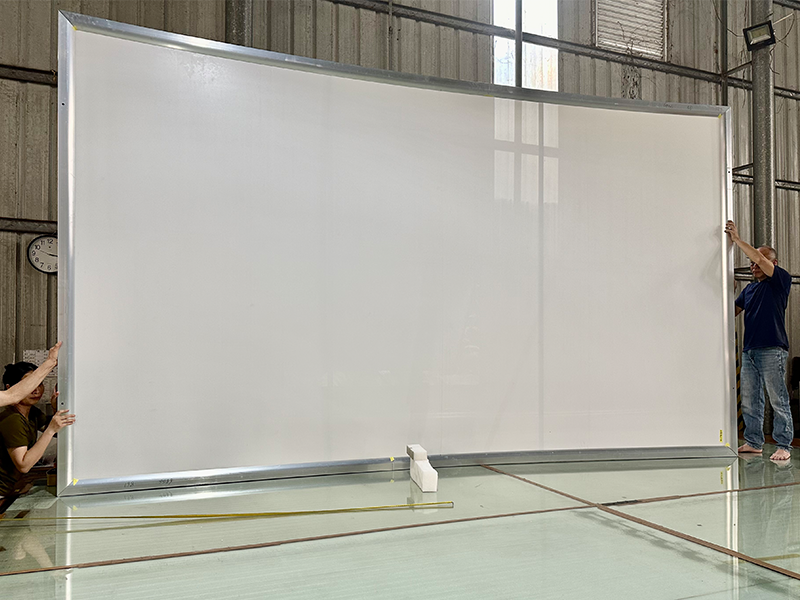
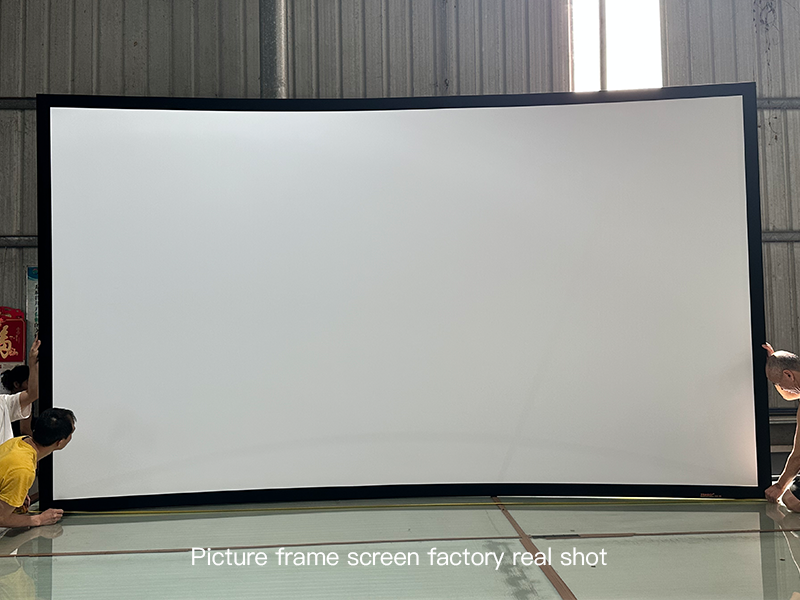
When implementing overall audio-visual solutions for overseas large-scale commercial immersive venues, corporate headquarters conference halls, and cultural tourism exhibition halls, curved projection screens have long become the core carrier for creating immersive visual experiences. Many overseas engineering general contractors and commercial space designers have had similar troubles: the picture quality is neat and smooth at the initial project delivery stage, but after years of seasonal temperature and humidity changes and long-term all-day operation, commercial immersive curved projection screens gradually develop physical deformations such as edge arching, radian deviation, and local depression. This not only reduces the presentation quality of high-end commercial scenarios but also incurs additional costs for later maintenance and rework, and even affects cooperative reputation—which is why the structural stability of curved projection screens has become a core consideration when selecting models for overseas B-end projects.
Why do flat projection screens rarely have such problems, but curved projection screens are more prone to deformation? In fact, the arc structure itself has inherent mechanical tension. After the screen is fixed on the arc frame, it bears radial tension and lateral extrusion at all times. Climate differences in different overseas regions further amplify this hidden danger of deformation: perennial high humidity and heat in Southeast Asia, huge temperature differences between day and night in the Middle East, and low-temperature frost in northern Europe in winter. Combined with large-size installation, the structural stability of large arc projection screens has naturally become a core assessment indicator for B-end overseas project selection. Many purchasers only focus on screen gain and viewing angle parameters, but ignore invisible cores such as frame structure, tension system, and back reinforcement, which is the fundamental reason why most overseas commercial projects experience deformation in the later stage.
Comparison Table of Mechanical Differences Between Flat Screens and Curved Screens
| Physical Characteristics | Flat Engineering Screens | Commercial Curved Screens | Core Conclusions/Selection Keys |
|---|---|---|---|
| Main Stress Direction | Vertical gravity, bidirectional tension | Radial tension + lateral extrusion | Curved projection screens require extra anti-torsion design to offset composite stress |
| Edge Stability | Easy to control with counterweight fixation | Prone to curling and wrinkling, relies on segmented tension | Commercial curved projection screens must adopt constant tension system to avoid edge deformation |
| Spatial Geometric Deviation | Uniform force without obvious deviation | Vulnerable to pincushion distortion under temperature and humidity changes | Adopt 6063-T5 rigid frame to lock original radian |
| Transportation & Assembly | Easy integral transport and simple installation | Oversized models need segmented transport with high assembly precision | Professional split splicing design balances logistics and structural integrity |
| Long-Term Maintenance Cost | Low, only regular cleaning required | Medium, annual radian and tension inspection needed | Choose professional custom manufacturers like ZSM to cut maintenance costs |
Custom Arc Projection Screen Frame: Material Selection and Wall Thickness Determine Basic Deformation Resistance
A qualified custom arc projection screen frame is the foundation for the entire screen to maintain its original radian. With years of deep engagement in overseas engineering, we never recommend customers to use ordinary recycled aluminum or non-standard thin-walled profiles. Almost all arc frames suitable for large commercial projects adopt 6063-T5 aviation-grade hard aluminum alloy. After artificial aging quenching treatment, the internal metal molecular structure of this profile is more stable, no invisible microcracks will be generated during bending and shaping, and it is not easy to relax under stress after long-term load-bearing.
In mechanical simulation, the central span of an ultra-wide curved screen is the most fragile point of the structure. ZSM’s engineering team has established a wall thickness matrix based on span and self-weight. When the span exceeds 8 meters, we not only increase the profile wall thickness to 3.5mm but also introduce bridge truss structure. This design bears load and counteracts inward contraction force caused by high screen tension, eliminating centripetal frame bending commonly seen in commercial projects. It is also one of the core reasons why ZSM maintains a low failure rate in overseas ultra-large curved projection screens projects.
Ultra-wide curved engineering projection screens of different sizes and installation scenarios have strict adaptation standards for frame wall thickness, and thicker is never more durable. Excessively thick walls increase self-weight and exceed the bearing limit of conventional overseas building walls; insufficient thickness leads to poor rigidity and inevitable distortion under long-term stress.
| Screen Size | Recommended Profile Wall Thickness | Main Overseas Application Scenarios | Structural Anti-Deformation Configuration Requirements |
|---|---|---|---|
| 120–150 inches | 2.0–2.5mm | Overseas corporate meeting rooms, small boutique exhibition halls | Standard single-layer frame, wall mounting with basic tension system |
| 180–250 inches | 2.5–3.0mm | High-end hotel banquet halls, brand flagship exhibition halls | Reinforced main frame + side strips, segmented constant tension springs |
| Over 300 inches ultra-wide | 3.0–3.5mm | Science and technology museum immersive halls, cultural tourism night tour venues | Double composite frame + full back support ribs + bridge truss structure |
ZSM has encountered many rework cases caused by improper profile selection in overseas projects. Some European clients chose low-grade aluminum to cut costs, and the frame of large arc projection screens distorted slightly within one year, resulting in focus plane offset and full replacement. In contrast, projects adopting ZSM 6063-T5 aluminum and bridge truss structure keep radian deviation within ±0.3mm even under long-term low-temperature operation in Northern Europe, fully meeting high-end commercial display standards.
Constant Tension Spring System: Offset Screen Deformation Stress Caused by Environment
The frame supports the overall radian of curved projection screens, while the tension system keeps the screen surface perfectly flat. Temperature and humidity changes trigger thermal expansion and contraction of fiberglass, PVC and nano screen materials. Premium anti-deformation arc projection screens adopt segmented unequal pitch high-carbon steel spring structure. Spring nodes are densely arranged at high curvature areas and sparsely distributed at gentle arcs, ensuring uniform stress across the whole screen.
65Mn high-carbon steel tension springs are processed with professional heat treatment to enhance fatigue resistance. Within a commercial service life of 5–10 years, elastic attenuation is controlled at an ultra-low industry level, avoiding spring fatigue and screen wrinkling. For curved projection screens in high-humidity environments, springs are galvanized for rust prevention, adapting to humid coastal and Southeast Asian climates and preventing tension failure from metal corrosion, which has been fully verified in ZSM aquarium and coastal exhibition projects.
Bionic Back Support Ribs: Geometric Reinforcement for Ultra-Wide Engineering Screens
For ultra-wide curved engineering projection screens over 5 meters in span, frame and tension system alone cannot guarantee long-term stability. Transportation vibration, hoisting pressure and long-term gravity sag may damage the original arc shape. Bionic exoskeleton back support ribs are essential for large overseas commercial projects. Longitudinal ribs are arranged at fixed intervals, and transverse ribs fit perfectly with curved radian, dispersing screen weight evenly to wall or steel structure and avoiding torsional deformation from local overloading.
Overseas cross-border projects face bumpy sea transportation in containers. ZSM equips export curved projection screens with professional anti-torsion brackets to lock original radian parameters before delivery, minimizing physical deformation during transit and eliminating the need for secondary radian calibration after installation, greatly improving installation efficiency for overseas projects.
Adaptation to Extreme Regional Environments: Special Solutions for Large Temperature Difference and High Humidity Scenarios
Overseas B-end projects cover global climate zones, and universal screen structures cannot fit all regions. Commercial curved screens for large temperature differences are customized for the Middle East and Northern Europe with extreme day-night and seasonal temperature gaps. We precisely match the thermal expansion coefficient of screen material and aluminum frame, controlling deformation deviation within a safe range to prevent frame separation and surface bulging under drastic temperature changes. In the Middle East, ZSM adopts high-temperature resistant screen materials and thermal expansion optimized frames to maintain perfect flatness even with 20℃ day-night temperature difference.
For tropical rainforest and coastal humid areas, frame anti-corrosion and screen mildew prevention are equally important. Frames adopt anodization and fluorocarbon double coating, passing over 1000 hours salt spray test. Screens are blended with food-grade mildew-proof ingredients, with reserved back ventilation grooves to avoid moisture accumulation and mold growth, protecting the structural integrity of commercial immersive curved projection screens. For coastal salt spray environments, ZSM provides customized anti-corrosion treatment to extend service life over 10 years.
FAQ
Q: Overseas shipping cost is high, how to balance segmented transportation and structural integrity for oversized curved projection screens?
A: ZSM adopts patented high-precision plug-in internal reinforcement design. The long frame is split into standard 2-3 meter sections, locked by embedded CNC aluminum alloy connectors, keeping assembly radian deviation within ±0.5mm. It reduces overseas shipping volume and cost while avoiding extrusion deformation, complying with logistics restrictions in different countries.
Q: Can thickening the frame of commercial curved projection screens completely avoid long-term deformation?
A: It cannot. Structural stability relies on balanced material hardness, mechanical design and reasonable wall thickness. Blindly thickening only increases self-weight, overloading wall mounting points and causing loose fixation and frame offset. High-end overseas projects prioritize material grade and structural design. ZSM’s 6063-T5 aluminum plus bridge truss structure delivers far better anti-deformation performance than ordinary thick low-grade aluminum.
Q: The projected image edge turns blurry after years of use, how to distinguish projector failure from curved projection screens deformation?
A: Project a pure white static image and turn off dynamic effects. Regular edge blurring and radian dislocation usually result from frame or tension system deformation; partial blurring is mostly caused by projector lens or focus error. Overseas engineering teams use laser flatness detectors to locate deformation accurately, and ZSM provides on-site inspection and debugging to cut clients’ maintenance costs.
Q: How to extend the service life of anti-deformation arc projection screens for long-term overseas commercial operation?
A: Daily maintenance is simple. Keep the installation space ventilated and dry, avoid direct air conditioning wind and strong sunlight exposure. Inspect radian and tension once a year and adjust minor sagging timely. Choosing export-focused manufacturers like ZSM gains exclusive climate-adapted structural solutions and long-term technical support to maximize screen service life.
Q: How do outdoor curved projection screens resist wind, rain and UV erosion in overseas cultural tourism projects?
A: ZSM customizes outdoor anti-aging curved projection screens for tourism projects. Frames adopt weather-resistant 6061-T6 aluminum alloy with fluorocarbon and anti-UV coating to prevent aging. Screens use outdoor tear-resistant and mildew-proof materials with edge waterproof sealing. Optimized back support adds windproof reinforcements to maintain structural stability under harsh outdoor weather conditions.
For overseas B-end commercial projects, the structural stability of curved projection screens is the perfect integration of material science, mechanical design, craftsmanship and climate adaptation. With years of focus on overseas high-end curved projection screens customization, ZSM is familiar with global climate features and engineering standards. We provide one-stop customized solutions from material selection and structural design to transportation and installation, eliminating long-term physical deformation risks, cutting post-operation maintenance costs and upgrading project overall quality and market reputation.
 Scan QR Code
ZSMSCR Facebook
ZSMSCR Instagram
ZSMSCR X
ZSMSCR YouTube
ZSMSCR TikTok