Welcome to Zsm Audiovisual Equipment(guangzhou)co.,ltd.

news
-
Home Theater Audio Troubleshooting: Solutions from No Sound to Distortion
4 Core Causes of Audio Failures During Movie Nights “Just hung your custom projection screen but the audio cuts out during the movie?” This scenario is common in home theaters. According to a 2024 audio equipment repair report, 35% of audio faults stem from wiring issues, while 22% result from mismatched amplifiers and speakers . Here are the key culprits: Connection Failures: Loose power sockets and poor audio cable contacts are top issues, especially after moving projection equipment . Low-quality sockets with weak phosphor copper strips cause voltage fluctuations and noise . Amplifier Malfunctions: Capacitor damage and burnt amplifier tubes account for 60% of amp issues. Dust buildup on volume potentiometers causes erratic volume (repairable for just $0.30)...Learn more -
Projection Screens Making You Dizzy? You’ll Regret Not Reading This!
Nowadays, there are countless projection screen brands on the market, leaving consumers overwhelmed. A mix of imported and domestic brands flood the market, with varying quality levels. Prices range from a few hundred yuan to several hundred thousand yuan, making it difficult for consumers to decide. Even many consumers have the misunderstanding that “using a screen is almost the same as projecting onto a white wall.” In fact, all of this stems from a lack of understanding of projection screens. Moreover, recently many people have sent private messages asking how to choose a projector screen. Although choosing a screen is less technically demanding than choosing a projector, it’s still hard to explain it in one sentence. So I’ve compiled the latest 2025 projector screen ...Learn more -
Do You Really Need a Projection Screen? 2025 Tests: Why White Walls Fall Short
1. Core Question: Do High-Brightness Projectors Still Need Screens? “With my 3500-ANSI-lumen projector, is a white wall enough?” This is the top question from global projection users in 2025. According to Futuresource’s Q2 2025 report, mainstream home projectors now reach 3500-6000 ANSI lumens, with laser models accounting for over 52% of global sales. However, real-world tests show: even with a 6000-ANSI-lumen laser projector, white wall images are still 35%-45% dimmer than ambient light rejecting (ALR) screens. 2. White Wall vs. Projection Screen: 2025 Global Spec Comparison Performance MetricRegular White WallWhite Fiberglass ScreenFresnel ALR Screen (2025 Global Favorite)Brightness Gain0.7-0.91.3-1.61.9-2.4Contrast ImprovementNone18%-25%45%-65...Learn more -
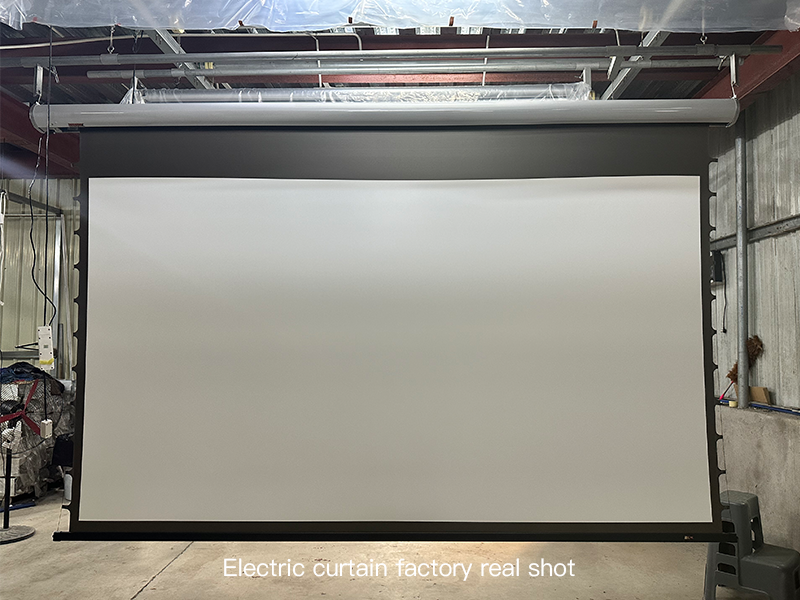
Does Holographic Projection Really Exist? The Ultimate Guide for 2025: From Principles, Illusions to DIY Screens
1. From Coachella to Louvre: Is That “Hologram” Real? At 2025 Coachella, Billie Eilish’s holographic duet with a virtual version of herself won the Cannes Lions Grand Prix for Innovation. The Louvre’s “Da Vinci 3D Revival” exhibit used custom projection screens to project floating Mona Lisa sketches, drawing 2.3 million visitors. These stunning visuals have boosted hologram hype—but 90% of commercial “holograms” are actually pseudo-holograms (not lab-grade true holography) . 2. Core Principles: Light’s “Memory” and “Reconstruction” True Holography: Interference + Diffraction Magic Recording Phase: Laser light splits into object beam (hitting the subject) and reference beam. Their interference create...Learn more -
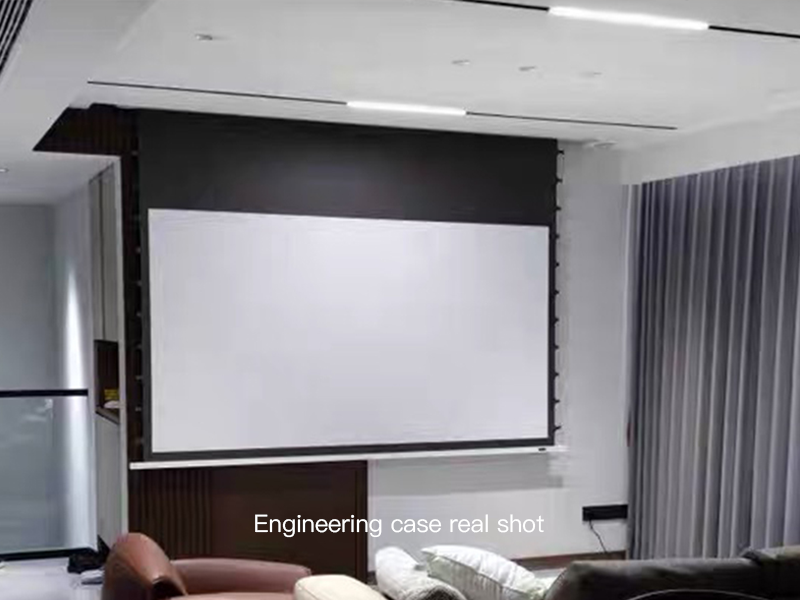
Projection Tab-Tension Screen : From Material Selection to Maintenance
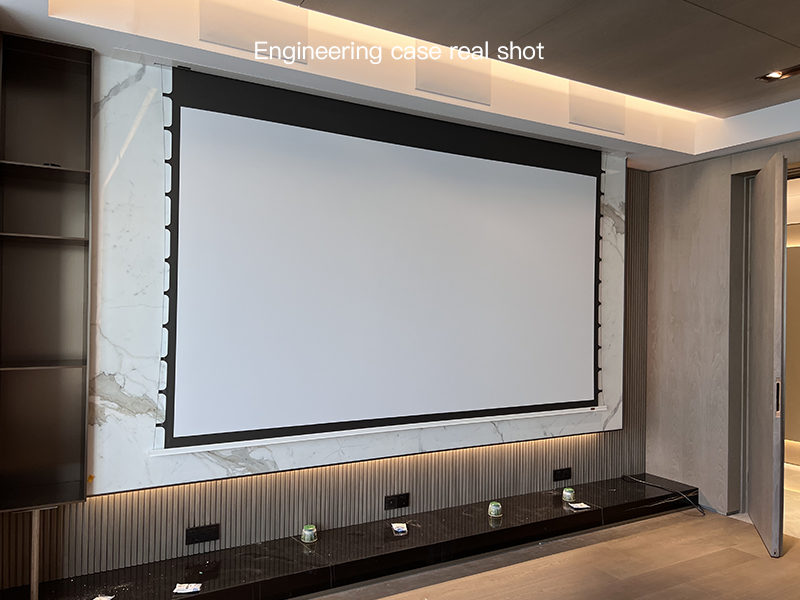
1. Core Value of Tab-Tension Screens In a middle school lecture hall, the teacher presses the remote, and the electric tab-tension screen descends smoothly. The 150-inch surface remains perfectly flat—this is its key advantage: dual tension from side wires and bottom weight bar eliminates curling and V-shaped wrinkles that plague regular electric screens over time. This design balances flexibility and flatness: ideal for commercial/educational settings with frequent use, and home theaters demanding immersion. For screens over 130 inches, tab-tension structure is critical to prevent deformation. 2. Material Selection Comparison Table Material TypeStructureFlatnessApplicationCustomization NotesPVC Soft ScreenFlexible base★★★★★Home theaters, premium meeting roomsMust...Learn more -
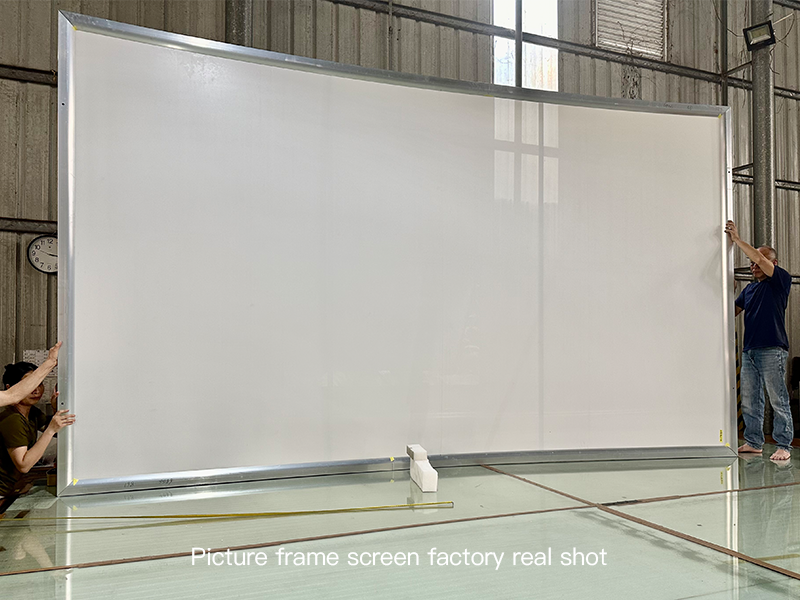
How to Choose Acoustic Transparent vs. Curved Projection Screens?
When building a home theater, screen selection is often more confusing than choosing a projector: Want to hide speakers without sacrificing sound quality? Tired of blurry edges on large screens? The solution lies in choosing the right acoustic transparent and curved projection screens. This article uses 2025’s latest industry data to break down the selection logic in simple terms. 1. Acoustic Transparent Projection Screens: The Secret to “Sound Through” Images Core Value: The Key to Sound-Image Integration Many mistakenly think these screens just “make speaker placement easier,” but their real role is achieving sound-image unity. Hiding front and center speakers behind the screen on the same horizontal line lets dialogue come directly from th...Learn more -

Discover 6 Ways Immersive Projection Screens Are Changing Everything in 2025
I. Immersive Projection Boom: Screen Demand Behind 2025 Market The global naked-eye 3D market has exceeded $50 billion in 2025, with China contributing nearly 40% of the share . As a core supporting technology, immersive projection is penetrating from traditional venues to full scenarios. Unlike standardized screens, custom screens have become a necessity in science museums, real estate and other fields through material adaptation, size optimization and environmental integration. A museum saw a 62% increase in exhibit interaction rate after adopting a circular custom screen, confirming the industry logic of “content is king, carrier is foundation”. II. 6 Application Scenarios & Custom Solutions ScenarioCustom Core RequirementRecommended MaterialEf...Learn more -
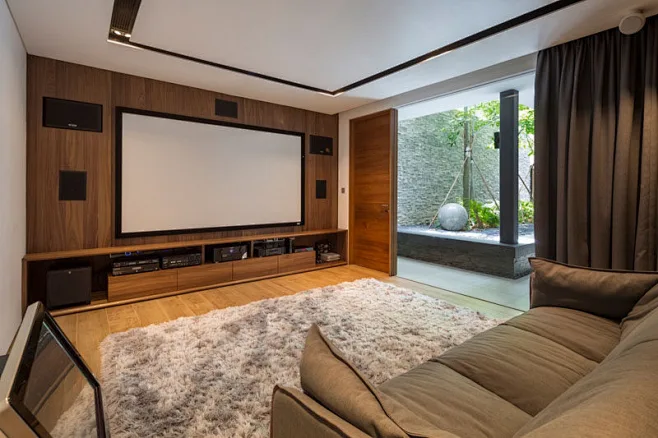
Is Your Projector Underperforming? The Wrong Screen Could Be Wasting Its Potential
1. Core Parameters: Understand Jargon in 3 Minutes Gain: A “Brightness Magnifier” That Isn’t Better When Higher Gain measures light reflection capacity (1.0 for perfect diffuser), while half-gain angle (viewing angle when brightness drops to 50% of peak) is more critical: 1.0-1.3 Gain: Ideal for home/meeting rooms, balancing brightness and 160° wide viewing angle >1.5 Gain: Prone to “bright center, dark corners”, only for small spaces with single viewing spot Quick formula: Actual brightness = Screen gain × Projector lumens (e.g., 1.1 gain + 1000 lumens = 1100 lumens effect) Size & Aspect Ratio: Match Precisely to Avoid Waste Aspect RatioApplication ScenarioCalculation Tip4:3 (1.33:1)Business presentationsWidth = Diagonal ...Learn more -
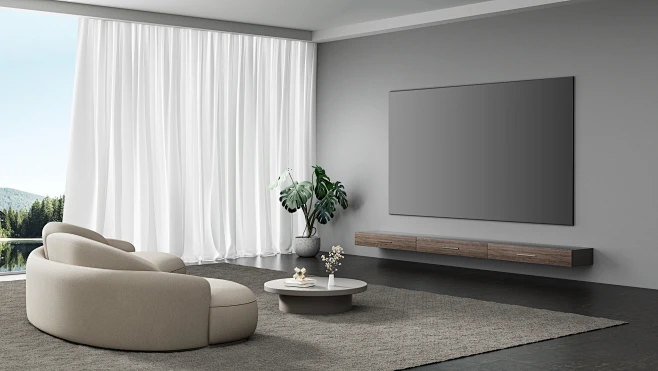
How to choose a projection screen? One formula + a simple test to help you find the best size
1. Stop Buying Blind! The “Golden Rule” of Projection Screen Size Lies in Viewing Distance Choosing the sofa position first before picking a screen? It’s a mistake 90% of households worldwide make! The 2025 Global Projection Screen Market Report shows that global demand for home projection screens has reached 31.2 million units, yet over 60% of users compromise their viewing experience due to wrong size choices. Decades ago, two renowned international audio-visual institutions, THX and ISF, revealed the core principle: the right screen size is determined by viewing distance . 2. Understand the Professional Formula in 3 Minutes The relationship between viewing angle and distance can be calculated by the formula: A=1/2tgα/2 (A = ratio of viewing distance...Learn more -
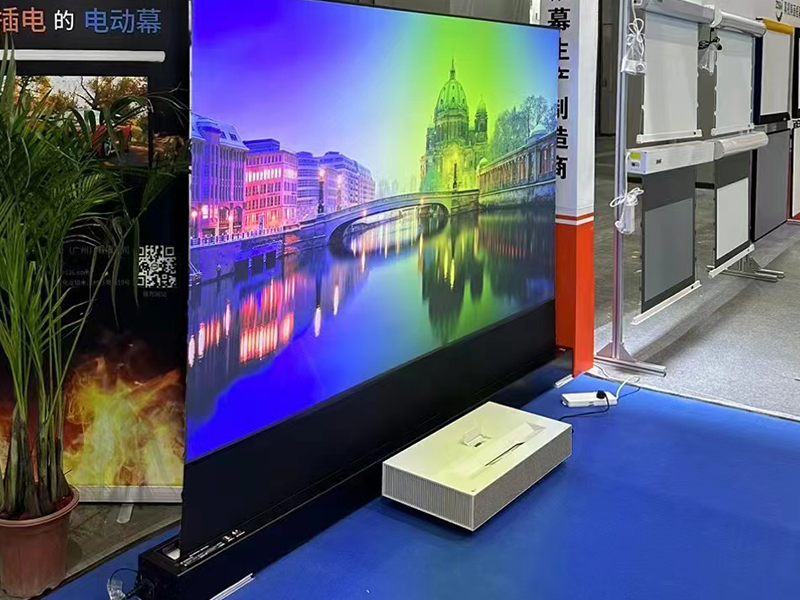
2025 Home Theater Projector Screen Tips: Avoid Pitfalls, Make Movie Nights Awesome
1. First Question: Do You Really Need a Projector Screen? Many people wonder if a white wall works as a screen. The answer is: Yes, but the effect is far worse! You must get a screen in these three cases: Substandard walls: With sockets, paintings, or non-white wallpaper Pursuing cinema-level effects: Walls can’t solve grayish images or low contrast Special needs: Outdoor camping, renting a house (no drilling allowed) 2. Core Categories: Understand Screens in 3 Minutes 1. By Installation Type (Fit Different Home Scenes) TypeFeaturesSuitable ScenariosManual PullHand-operated, portableRenting, temporary useElectricRemote-controlled, hiddenLiving room, furnished homeFloor-standingNo drilling, movableBedroom, outdoor campingFixed FrameMirror-flat, best i...Learn more