
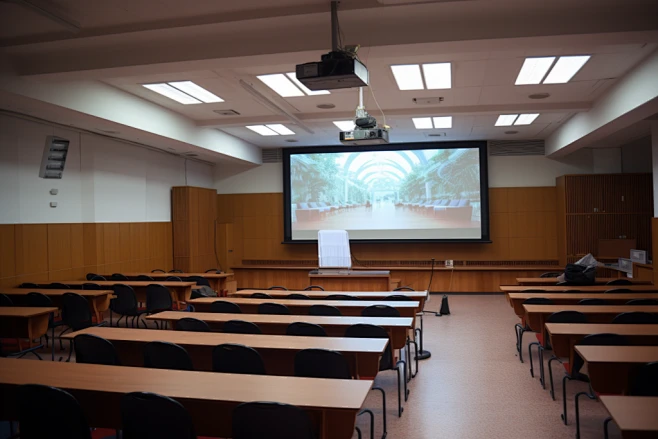
For commercial venues like large auditoriums and historic houses of worship, picking a suitable projector screen is never a simple consumer-level purchase. These spaces deal with mixed natural light from stained-glass windows, stage spotlights, and fixed indoor lighting, making High ambient light screen performance the top priority for B-end buyers. A poorly matched screen will render even high-lumen projectors ineffective, leading to blurred images, faded contrast, and a poor experience for hundreds of audiences—especially for Projector screen for church with windows, where natural light interference is more prominent.
When planning large-scale projection projects, most engineering teams and facility purchasers struggle with choosing between different screen technologies, calculating accurate dimensions, and balancing acoustic effects with architectural aesthetics. Below we share practical, engineering-grade selection strategies tailored for Church projection screen and Auditorium projector screen scenarios, helping you make cost-effective and long-term stable choices for high ambient light environments, while also covering key concerns like Fire-retardant projection fabric standards and installation solutions for special spaces.
Choosing Between ALR vs high gain screens for Bright Venues
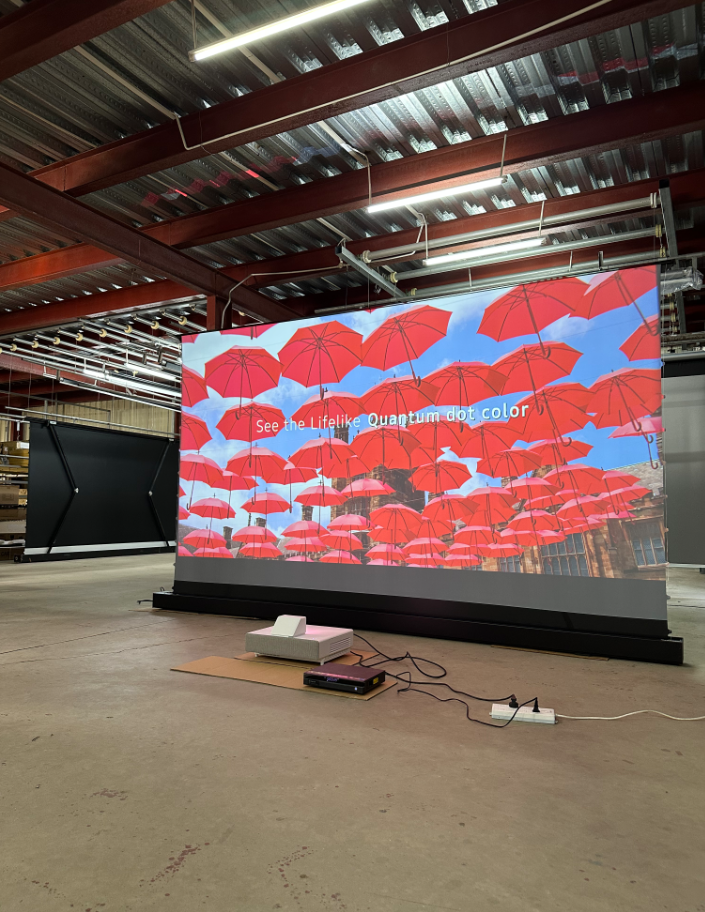
The core conflict in high ambient light spaces lies in filtering unwanted light while retaining the projection’s original brightness and color. ALR vs high gain screens represent two completely different technical paths, each suitable for distinct B-end project scenarios. Unlike consumer-level screens, commercial-grade projector screen requires strict parameter matching with venue conditions, and we have summarized their key performance parameters and application scenarios in the table below for direct reference in project bidding, procurement, and acceptance.
| Selection Dimension | Ambient Light Rejecting Screen (ALR) | High Gain Screen (High Gain) |
| Contrast Performance | Absorbs more than 90% of ambient stray light, static contrast up to 10000:1, ensuring clear picture details even in bright environments | Relies entirely on projector lumen output, static contrast is 3000:1-5000:1, and picture details are easily blurred under strong ambient light |
| Picture Uniformity | Excellent, no hotspots, the brightness difference between the center and edge of the screen is ≤5%, suitable for multi-angle viewing | There is a central highlight area (Hotspotting), the brightness difference between the center and edge can reach 15%-25%, which affects the viewing experience of off-center audiences |
| Main Standards | Complies with ISO 9001 quality management system, NFPA 701 fire retardant standard, meets the acceptance requirements of commercial public venues | Complies with UL 94-V0 flame retardant standard, EN 13501 B2 fire rating, suitable for general commercial venues with low fire protection requirements |
| B-end Recommended Value | Suitable for medium and large venues of 150-250 inches, especially Projector screen for church with windows and auditoriums with unilateral strong light | Suitable for extra-large auditoriums above 300 inches, such as convention centers and large worship venues that require long-distance viewing |
In actual church and auditorium projects, we often suggest that B-end customers prioritize High ambient light screen (ALR) for fixed venues with completed interior decoration—this not only avoids the additional cost of later light transformation but also ensures stable picture quality for long-term use. For Projector screen for church with windows, ALR screens can effectively filter the scattered light from the glass, preventing the picture from being washed out by natural light. For temporary large-scale events or budget-limited new auditorium projects, high gain screens can be a flexible alternative, but on-site light simulation tests must be conducted before bulk ordering to prevent uneven picture brightness and avoid project rework.
How to calculate screen size for auditorium: Engineering-grade Dimension & Layout Standards
How to calculate screen size for auditorium is a key step in B-end projection engineering, directly related to audience experience and later project acceptance. Unlike small home theaters, large commercial venues have complex audience distribution and long viewing distances, so we adopt the industry-recognized 4/6/8 engineering rule for large venues, which has been verified in hundreds of Auditorium projector screen installation projects worldwide. The specific calculation standards and layout requirements are as follows:
- Screen height = 1/6 of the distance from the screen to the farthest audience. For example, if the farthest viewing distance is 30 meters, the screen height should be at least 5 meters to ensure that text and image details are clearly visible to rear-row viewers, which is especially critical for Church projection screen that needs to display scriptures and hymns.
- First-row viewing distance ≥ 2.2 times the screen height. This can avoid visual fatigue and neck discomfort caused by being too close to the screen, which is suitable for long-time meetings, worship activities, and academic lectures.
- Bottom of the screen ≥ 1.2m above the ground, avoiding obstruction by stage equipment, railings, or audience heads. For venues with steps or terraces, the height can be appropriately increased to 1.5m to ensure unobstructed viewing for all audiences.
- For Church projection screen, the reserved installation space should retain 15%-20% margin for later size adjustment. This is because many churches may expand their venue or upgrade their projection system in the future, and the reserved space can reduce the cost of secondary modification.
In terms of aspect ratio, 16:10 has replaced 16:9 as the mainstream choice for modern religious and auditorium venues. This ratio is more suitable for displaying hymns, scriptures, meeting agendas, and multi-window simultaneous playback, which fits the daily use needs of such venues better. For ultra-large venues with more than 800 seats, customized 21:9 wide screens can be selected to improve picture utilization and space aesthetics. For Acoustically transparent screens for auditoriums, the aspect ratio can be customized according to the size of the sound system and the layout of the stage to achieve the best sound and picture integration effect.
Acoustic Integration & Hidden Installation: Acoustically transparent screen for church, Acoustically transparent screens for auditoriums & Large motorized screens for high ceilings
For churches with professional choirs and high-fidelity audio systems, Acoustically transparent screen for church has become a standard configuration for high-end projects. Similarly, Acoustically transparent screens for auditoriums are widely used in large conference venues and performance halls that require high acoustic effects. The woven or micro-perforated structure (0.15mm-0.4mm aperture) of these screens ensures sound transmission loss ≤0.8dB, allowing speakers to be placed directly behind the screen to achieve sound-image synchronization. This design not only optimizes acoustic effects but also saves stage space, which is highly valued by architectural design teams and facility managers of overseas B-end customers.
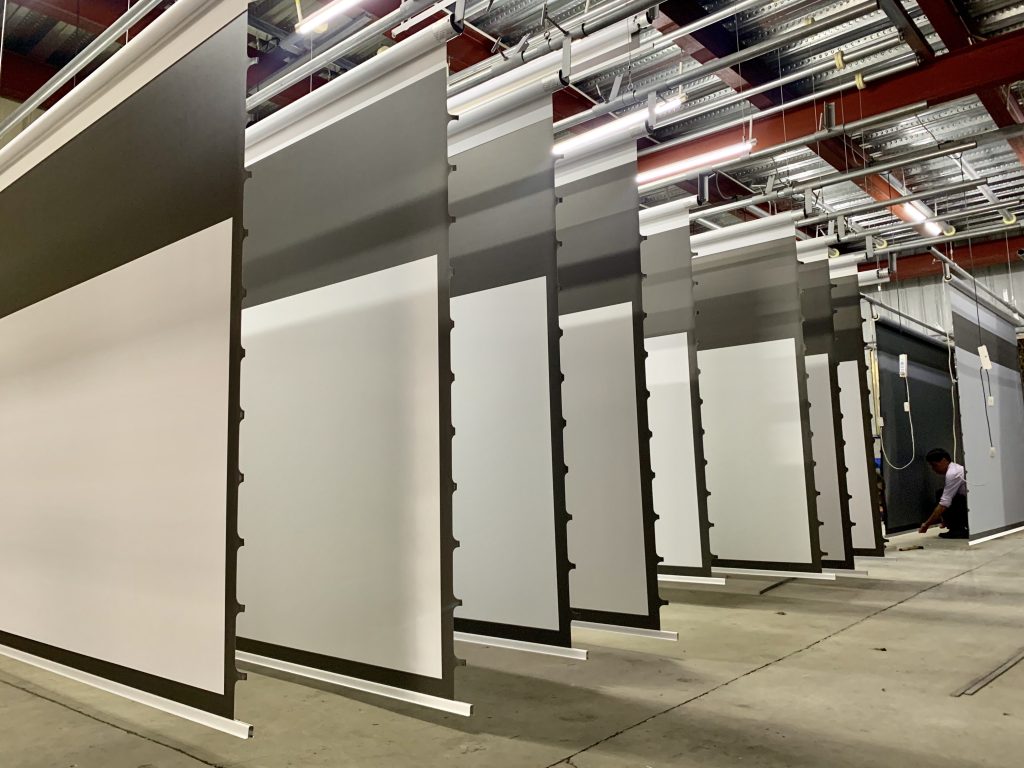
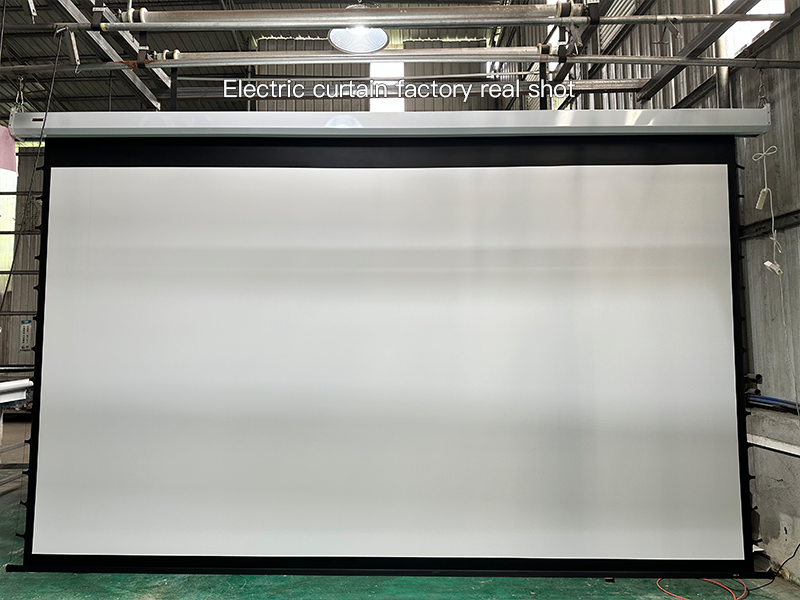
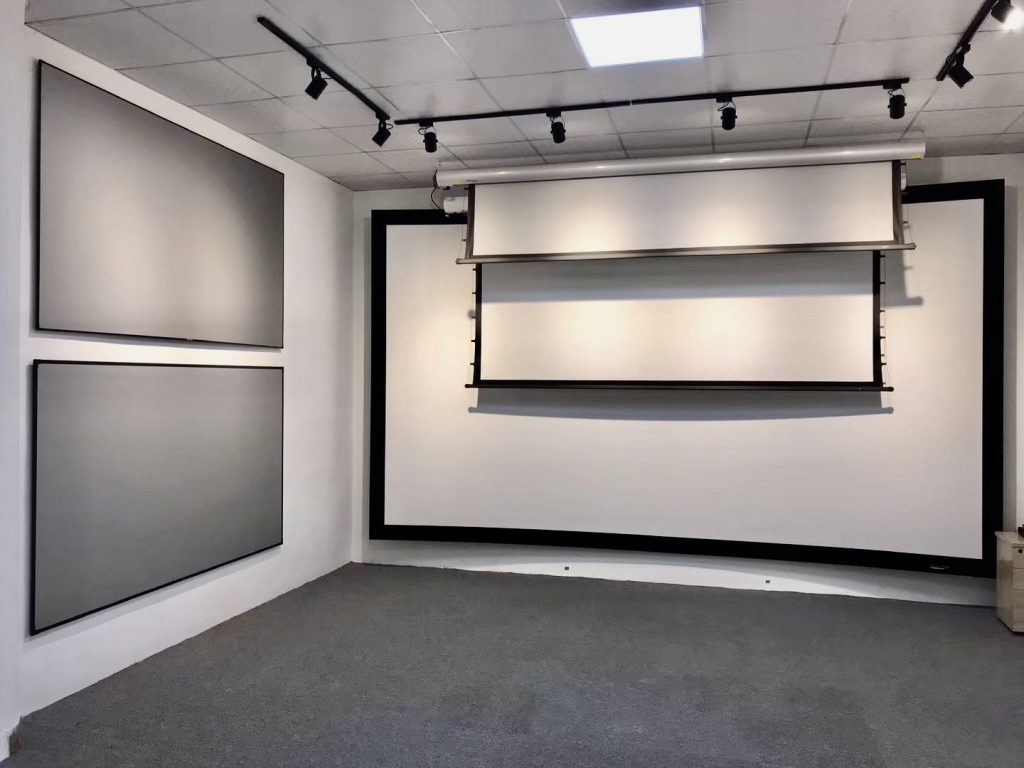
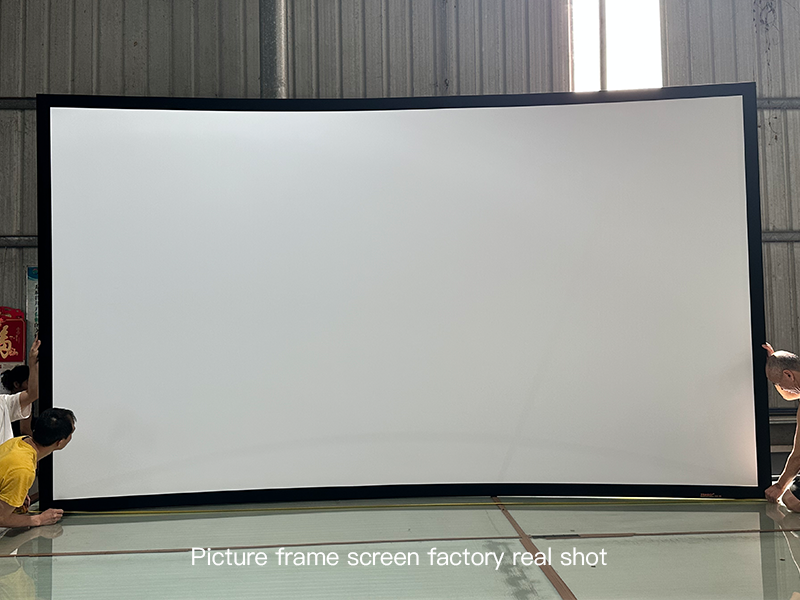
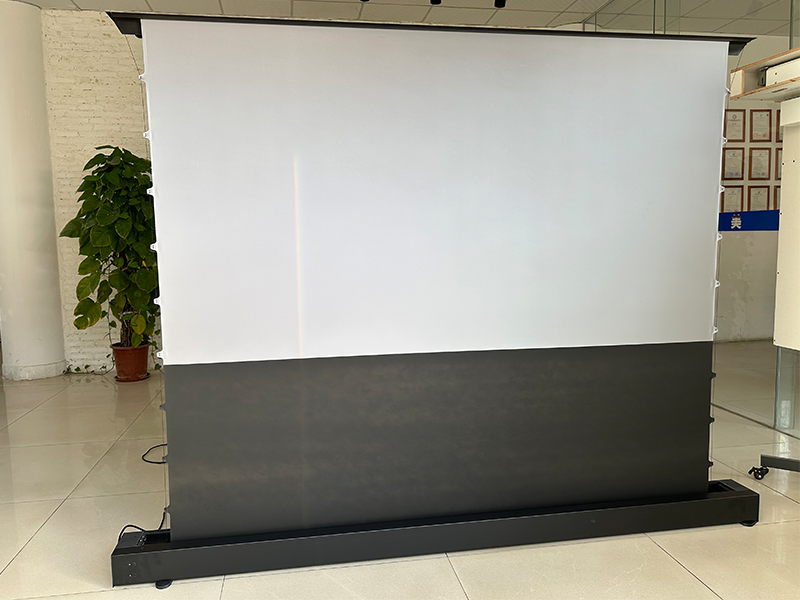
For historic churches, high-standard auditoriums, and venues with special architectural structures, such as those with high ceilings, Large motorized screens for high ceilings with tab-tensioned systems are the optimal solution. These commercial-grade electric screens use reinforced aluminum alloy tubes and wear-resistant fabrics, supporting stable lifting of 200-450 inch large sizes. The lifting stroke can be customized according to the ceiling height (up to 10 meters), and the silent motor (noise ≤35dB) ensures that it will not affect the ongoing activities during lifting. When not in use, they can be fully retracted into ceiling boxes, without destroying the original decorative style of the venue.
Many B-end purchasers often have questions about product standards and usage effects. We have sorted out the most common FAQs to help you quickly solve practical problems in project planning:
FAQ: Common Problems & Solutions for B-end Purchasers
- Q: Can Acoustically transparent screen for church and Acoustically transparent screens for auditoriums meet the fire protection requirements of public places? A: Yes. All commercial large-venue screens customized by ZSM comply with Fire-retardant projection fabric standards, including NFPA 701 (American standard) and EN 13501-1 (European standard). The flame retardant performance of the screen fabric reaches the B1 level, which can effectively delay the spread of fire and fully meet the acceptance requirements of auditoriums, churches, and other public venues. We can provide official test reports to ensure that your project passes the local fire inspection smoothly.
- Q: How to ensure the stability and safety of Large motorized screens for high ceilings during long-term use? A: ZSM’s Large motorized screens for high ceilings adopt a dual braking system (mechanical braking + electronic braking) to prevent the screen from falling accidentally. The guide rail uses high-strength steel, which can bear the weight of large-size screens (up to 150kg) for a long time. In addition, we provide anti-drop devices and windproof design, which are suitable for venues with high ceilings and large air circulation, ensuring safe and stable operation for 8-10 years.
- Q: For Projector screen for church with windows, how to further improve the light rejection effect besides choosing ALR screens? A: On the basis of selecting High ambient light screen (ALR), we can provide customized light-blocking edge designs to reduce the impact of side light. At the same time, we can cooperate with the venue’s lighting system to provide light adjustment suggestions, such as installing dimmable curtains or adjusting the angle of stage spotlights, to achieve the best projection effect. Our technical team can also conduct on-site light detection and provide targeted optimization plans.
- Q: What are the key points of Fire-retardant projection fabric standards that need to be paid attention to for overseas B-end projects? A: Different countries and regions have different fire protection standards. For example, North American projects need to comply with NFPA 701, European projects need to meet EN 13501-1, and Asian projects usually refer to national fire protection standards. When purchasing, you need to confirm the local fire protection requirements in advance. ZSM can customize screen fabrics that meet the corresponding standards according to your project location, and provide authoritative test reports to avoid project acceptance risks.
Customized Solutions & Project Support from ZSM
As a professional manufacturer focusing on custom projector screen for global B-end customers, ZSM has more than 15 years of experience in commercial projector screen R&D, production, and engineering services, providing one-stop solutions for Church projection screen, Auditorium projector screen, Projector screen for church with windows, Acoustically transparent screens for auditoriums, and Large motorized screens for high ceilings projects.
For overseas B-end customers, we provide comprehensive project support to solve the pain points of cross-border procurement and installation: 1. Customized services: Support size, fabric, aspect ratio, and installation structure customization, and can provide samples for on-site testing before bulk ordering; 2. Standard compliance: All products comply with international standards such as ISO 9001, NFPA 701, and EN 13501-1, and meet Fire-retardant projection fabric standards of various countries; 3. Logistics and packaging: Provide seaworthy packaging to avoid damage during transportation, and cooperate with well-known international logistics companies to ensure on-time delivery; 4. Technical guidance: Provide detailed installation drawings, operation manuals, and online technical training, and send professional engineers to overseas project sites for guidance if necessary.
Whether you need High ambient light screen for severe light interference environments (such as Projector screen for church with windows), Acoustically transparent screens for auditoriums for acoustic optimization, Large motorized screens for high ceilings for special architectural structures, or custom screens that meet specificFire-retardant projection fabric standards, ZSM can provide targeted products and solutions that meet commercial engineering standards, helping you reduce project costs and improve project quality.
Final Tips for B-end Purchasers
When selecting projector screen for auditoriums and houses of worship, B-end buyers should not only focus on price but also combine venue lighting, audience distribution, acoustic requirements, local fire protection standards, and later operation and maintenance costs. A suitable screen can not only improve the projection effect but also reduce the configuration cost of the projector, extend the overall service life of the projection system, and avoid the loss caused by project rework.
If you need customized solutions, on-site parameter simulation, sample testing, or bulk quotation for Auditorium projector screen, Church projection screen, Projector screen for church with windows, Acoustically transparent screens for auditoriums, Large motorized screens for high ceilings, or Fire-retardant projection fabric standards related projects, you can contact ZSM at any time. We have rich experience in global high ambient light screen engineering projects and can provide you with professional, practical, and cost-effective product and installation plans.
 Scan QR Code
ZSMSCR Facebook
ZSMSCR Instagram
ZSMSCR X
ZSMSCR YouTube
ZSMSCR TikTok